

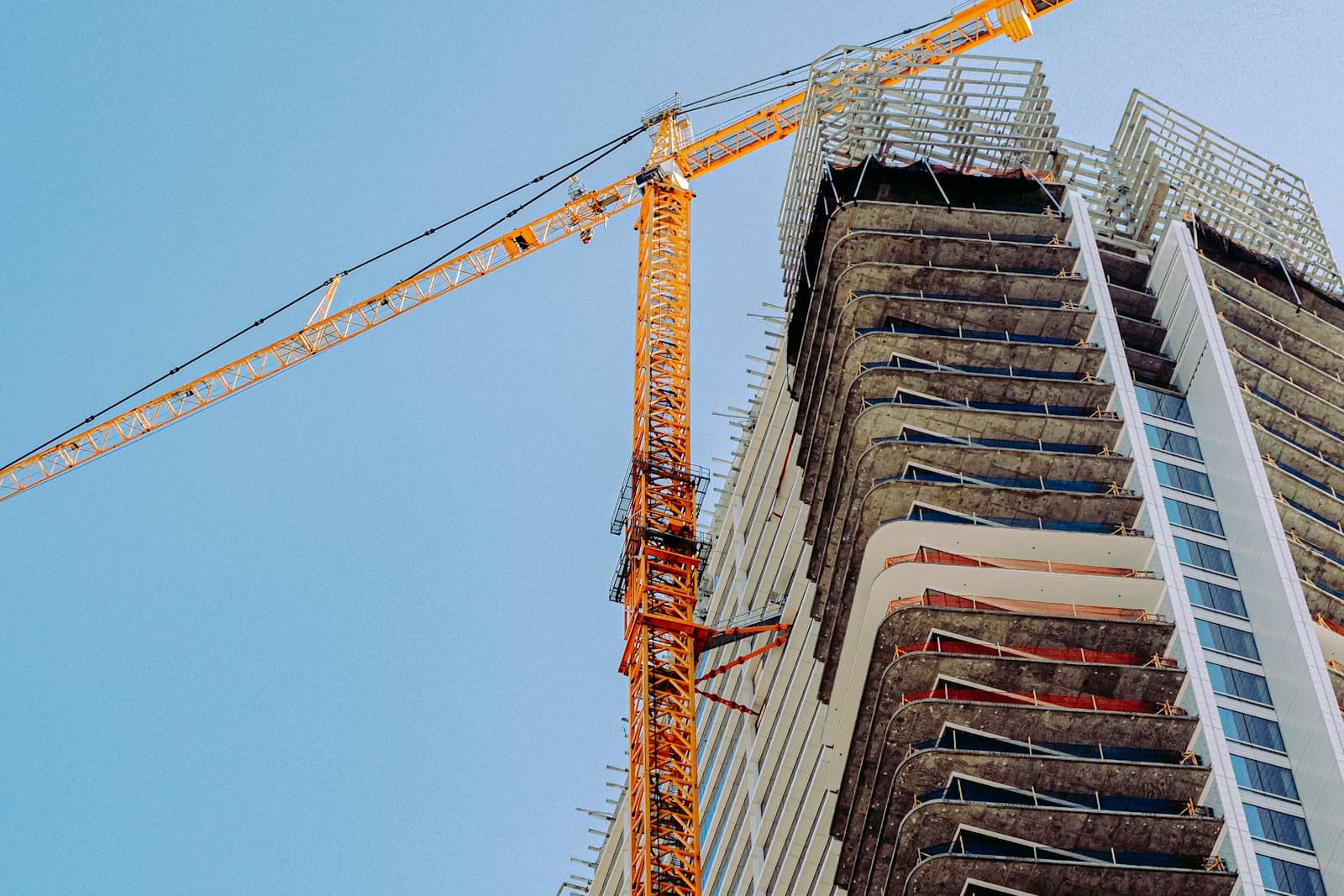
Buying off-plan means you sign with a developer and pay in stages while the building goes up. Two rules protect you: your money must go into an escrow account that belongs to the project, and your purchase must be registered with the Dubai Land Department (DLD) on its interim register, known as Oqood. You can check both yourself, and you should before you pay anything beyond a booking amount.
This guide covers how those protections work, what a payment plan commits you to, how to check a project, what happens when things go wrong and what to do at handover. It builds on our practical guide to buying property in Dubai, so it skips the basics. It is general information, not legal or investment advice, and it makes no forecasts about prices or returns.
How escrow protects your payments
Under Law No. 8 of 2007, a developer that sells off-plan must open a separate escrow account for each project with a bank accredited by DLD. Every payment from buyers goes into that account, the money can only be spent on building that project, and the developer's creditors cannot attach it.
The bank releases money in stages. When the developer reports a construction milestone, the escrow bank's engineer inspects the site before any payment goes out to contractors. Once the project has its completion certificate, the bank must hold back 5% of the account until a year after the units are registered in buyers' names. DLD describes that retention as a guarantee that defects will be put right.
Escrow has limits, though. It protects money that is still in the account, not money already spent on construction, and it does nothing for a payment made anywhere else. Never send an instalment to a broker, a sales agent or a personal account, however the request is worded.
The law also stops developers selling too early. Law No. 13 of 2008 bars off-plan sales until the developer has taken possession of the land and obtained its approvals, and an off-plan project cannot be advertised or shown at exhibitions without DLD's written approval.
Oqood registration and when the 4% is due
Every off-plan sale must be entered on DLD's interim register. The developer does this through DLD's Oqood portal, and DLD requires the sale and purchase agreement (SPA) to be registered within 90 days of signing. The law treats an unregistered off-plan sale as void, so the registration certificate DLD emails you matters more than any receipt from the sales office.
The DLD registration fee is 4% of the price. DLD's schedule splits it into 2% for the seller, here the developer, and 2% for the buyer, but your SPA decides who actually pays. Whatever the split, the fee is collected at Oqood registration, early in the purchase, not at handover. DLD also charges the developer a fixed AED 1,000 for registering the sale through Oqood (as of October 2026), so if your SPA adds a separate registration or admin charge, ask what it covers. Our guide to the full cost of buying property in Dubai puts these fees in context.
If a developer has not registered your contract, you can apply to DLD yourself with your SPA and supporting documents. At completion, the Oqood record is converted into a title deed. Because the registration fee was paid at the start, that step only carries small fixed fees, such as AED 250 for the title deed and AED 250 for the map.
What a payment plan commits you to
Developers set their own payment plans, so read the schedule as closely as the price. Think of it in three parts: what you pay at booking, what you pay during construction and what is left for handover or later. The construction instalments are tied either to dates or to progress, and the difference matters.
- Date-based instalments fall due whether or not the building is on schedule. If the project slips, you can end up paying for progress that has not happened.
- Construction-linked instalments follow the work. According to DLD, when a developer asks for a payment tied to a completion stage, you can ask for a letter from the project consultant confirming that stage, and you are not obliged to pay until it is confirmed.
- Post-handover plans let you take the keys while still paying the developer. DLD registers a title deed in your name only once you have met all your contractual obligations, so expect to stay on the interim register until the last instalment is paid.
If you plan to borrow, Central Bank rules cap lending on off-plan property at 50% of its value, and the bank must use your share of the price before it pays the developer anything. In practice you fund at least the first half yourself. Our guide to mortgages for expats covers the rest of the bank's rules.
Say you agree to buy a AED 1.6 million apartment on a plan that asks for 40% during construction and 60% at handover. Before handover you need AED 640,000 for instalments, plus AED 64,000 if your SPA puts the whole 4% DLD fee on you. If you intend to finance the AED 960,000 due at handover, remember that the bank lends against its own valuation of the finished unit, not the price you agreed years earlier, and any gap is yours to fund.
How to check a developer and a project before you pay
- Validate the advert. DLD issues advertising permits through its Trakheesi system. Ask for the permit number and check it with the licence and permit validation service on the DLD website or the Dubai REST app.
- Confirm the developer is licensed. DLD publishes its list of licensed developers on its website and in Dubai REST.
- Look up the project. DLD's Project Status Enquiry, searchable by project name, project number or land number, shows the completion percentage and project details. Dubai REST adds site photos, the escrow account number and, once you own a unit, the payments due.
- Match the escrow account. The account on your payment instructions should match the one DLD shows for the project, at a bank on DLD's list of approved escrow trustees.
- Check the land. DLD's investor guide suggests confirming that the developer owns the plot or has a development agreement with the owner. If you are not a UAE or GCC national, you can only own in designated areas, so check the plot's status too; our guide to freehold areas in Dubai shows how.
- Read the SPA before the deposit. Look for the completion date, any grace period the developer has given itself, what you receive if it overruns and what the developer may change in the specification.
If you cannot find the project in DLD's records, stop until you can.
When things go wrong
Delays
The SPA governs delays, which is why its completion clause deserves more attention than the brochure. DLD will not cancel a contract because a buyer asks; it can try to reconcile the two sides, but a buyer who wants to terminate has to go to court. The Real Estate Regulatory Agency (RERA) monitors progress, and where a project stalls without good reason it can give the developer time to recover and then start cancellation proceedings.
Cancelled projects
If RERA cancels a project by a final decision, or the developer never starts work for reasons outside its control, the developer must refund all buyers' payments under the escrow law. DLD's liquidation process collects what is left in the escrow account and pays buyers in full or in proportion, depending on the balance. That is the practical reason to pay only into escrow: it is the money the process can reach.
If you cannot pay
If you miss instalments, the developer must notify DLD, which gives you 30 days' written notice and may try to broker a settlement. If you still do not pay, Article 11 of Law No. 13 of 2008, as amended by Law No. 19 of 2020, caps what the developer may keep.
| Project completion | What the developer can do |
|---|---|
| Over 80% | Keep the contract and claim the balance, ask DLD to auction the unit, or terminate and keep up to 40% of the price |
| 60% to 80% | Terminate and keep up to 40% of the price |
| Under 60%, work started | Terminate and keep up to 25% of the price |
| Work not started, for reasons outside the developer's control | Keep nothing: it must refund everything you paid |
Any excess must be refunded within a year of termination, or within 60 days of the unit being resold, whichever is sooner. DLD's procedure also requires the developer's warning to claim only unpaid instalments for the unit, not fines or admin fees. Talk to the developer before the notice period ends: losing up to 40% of the price is an expensive way out.
Handover and snagging
Before you accept the keys, inspect the unit, or pay a snagging inspector to do it, and give the developer a written list of defects with photos. Law No. 6 of 2019 on jointly owned property sets two warranties that a contract cannot override:
- Structural defects: the developer remains liable for 10 years from the project's completion certificate.
- Installations: mechanical, electrical, plumbing and drainage defects are covered for one year from the handover of your unit.
One detail catches buyers out. If you refuse to take possession, for example to force repairs first, the one-year period runs from the completion certificate anyway. Delaying handover does not extend your cover, so it is usually better to take the unit with a recorded snag list than to leave it unclaimed.
If residency is part of your plan, check how off-plan units are treated in our guide to the Golden Visa through property before you choose a project. If you would like help checking a developer, project and contract before you commit, our real estate team can work through these steps with you.
Sources
- Dubai Land Department: registering an off-plan sale on Oqood
- Dubai Land Department: Project Status Enquiry
- Dubai Land Department: frequently asked questions on escrow and off-plan projects
- Dubai Legal Portal: Law No. 8 of 2007 on escrow accounts
- Dubai Legal Portal: Law No. 19 of 2020 amending the interim property register law
- Dubai Legal Portal: Law No. 6 of 2019 on jointly owned property
Frequently asked questions
Can I sell an off-plan unit before handover?
What is the difference between an Oqood certificate and a title deed?
How do I know my instalments are going into escrow?
Can I get a mortgage while the property is still off-plan?
Found this useful? Pass it on.